If you’ve ever stood in a busy warehouse, watching pallets glide 20 feet up a racking system and wondered how that equipment works, you’ve probably asked a question I hear almost every day from new and returning clients: What is the maximum lift height for a 5-ton electric forklift? As a supplier who’s spent the last 12 years building and supporting electric forklifts for small distribution centers, manufacturing plants, and cold storage facilities, I don’t just give a number and leave it at that. The answer isn’t a one-size-fits-all figure. It’s a calculation shaped by physics, engineering design, and the specific needs of your operation—and getting it wrong can lead to safety risks, wasted money, or equipment that’s not fit for purpose. Let’s break it down, step by step, so you know exactly what to look for when comparing 5-ton electric forklifts. Electric Forklift

First, let’s get one thing straight: when we talk about a 5-ton forklift, that 5-ton rating isn’t fixed. It’s the maximum capacity the lift can handle at its load center, which is a critical technical detail most operators gloss over. For nearly all standard 5-ton electric forklifts in our product line, the rated load center is 600 millimeters—meaning the center of the pallet, or the load, sits 600mm out from the face of the forks. This is the industry standard for most palletized goods, like packaged food, raw building materials, or consumer appliances. But when you start lifting that load higher, the capacity drops, and that’s where the maximum lift height question gets complicated.
Let’s start with the core engineering of a 5-ton electric forklift. Unlike internal combustion (IC) forklifts that rely on engine power and heavy fuel tanks for balance, electric forklifts use a battery pack mounted low in the chassis to distribute weight. That design makes them ideal for indoor use—they don’t emit fumes, they run quieter, and they have lower long-term maintenance costs—but it also limits how tall they can safely lift heavy loads. Lift height for forklifts is measured two ways: free lift and maximum lift. Free lift is the distance the forks can rise without the mast (the vertical assembly holding the forks) extending forward; this is key for tight spaces where you can’t lift the mast higher than the racking beams. Maximum lift is the total height the forks can reach when the mast is fully extended, which is what most people are asking about when they say “maximum lift height.”
For a standard 5-ton electric forklift with a 600mm load center, the maximum lift height is typically between 3,000mm (10 feet) and 6,000mm (20 feet). Wait, that’s a huge range—why the difference? It comes down to two main choices manufacturers make: mast design and weight distribution. If you opt for a two-stage mast, which is simpler, lighter, and cheaper, its maximum lift height tops out around 3,000mm to 4,500mm (10 to 15 feet). That’s perfect for small warehouses with low ceiling heights, or operations that only need to store pallets on two levels of racking. But if you need to stack pallets higher, a three-stage mast is the way to go. Three-stage masts have an extra segment that telescopes upward, letting the forks reach up to 6,000mm (20 feet) while still leaving enough space above the load to place it on the top rack. That’s the sweet spot for many mid-sized manufacturing plants or distribution centers that need to maximize vertical storage without expanding their floor space.
But here’s the catch: as lift height increases, that 5-ton rated capacity drops significantly. When a standard 5-ton electric forklift lifts a load to 6,000mm (20 feet), its capacity is no longer 5 tons—it’s usually around 2.5 tons to 3 tons. That’s because the higher you lift a load, the more torque is required to keep the mast stable, and the forklift’s center of gravity shifts forward. Push the limits, and you risk tipping the forklift, damaging the mast, or even dropping a load. That’s why I always tell clients: never assume a 5-ton electric forklift can lift 5 tons at its maximum height. The only time that 5-ton rating applies is when the load is close to the ground, at lift heights of 1,000mm (3 feet) or lower. For any application that requires lifting more than a pallet full of boxes, you have to match your lift height to your actual required load weight.
Now, let’s talk about variables that can shift these numbers, because no two operations are the same. First is load center deviation. If you’re moving longer or wider pallets, like 1.2-meter pallets common in food distribution, the load center jumps to 750mm instead of 600mm. For a 5-ton electric forklift with a 750mm load center, the maximum lift height drops by about 10%—so a three-stage mast that could reach 6,000mm with a 600mm load center might only hit 5,400mm with a 750mm load. That might not sound like a lot, but if your warehouse’s top rack is at 5,500mm, that extra 100mm is the difference between fitting the load and having to adjust your entire storage system.
Another variable is attachment options. A lot of clients need specialized forks or attachments for their goods—clamps for barrels, side shifters to move pallets without repositioning the entire forklift, or rotators for bulk containers. Every attachment adds weight to the front of the forklift, which reduces both capacity and maximum lift height. Add a 200kg barrel clamp, and you might lose 500kg of capacity at the same lift height, or cut your maximum lift height by 300mm to 400mm. That’s why we always ask clients about their attachments early in the process, not as an afterthought—adding them later can render your forklift’s maximum lift height useless.
Environmental factors matter too, especially if you’re using your forklift in a cold storage facility or a warehouse with uneven flooring. Cold temperatures can reduce the performance of the electric battery, which means less power to extend the mast, so maximum lift height might drop by 5% to 10% in freezers that run at -20°C. Uneven flooring also affects stability—if the forklift is sitting at an angle when lifting, the center of gravity shifts, so you can’t lift to the full rated height. We recommend leveling the floor or adjusting your operational area to reduce tilt if you’re operating in these conditions.
Let’s put this into real-world examples, because numbers on a spec sheet don’t mean anything until they fit your work. Last year, I worked with a small furniture manufacturing company in Ohio that needed to stack wooden pallets of dining tables 5.8 meters high in their warehouse. They initially asked for a 5-ton electric forklift, but they had a twist: their pallets were 1.2 meters long, so the load center was 750mm. When we crunched the numbers, a standard three-stage mast 5-ton forklift could only reach 5.4 meters at that load center—just enough for their top rack. If we’d tried to get a taller mast, the capacity would have dropped so low that they couldn’t lift a full pallet of tables without tipping. Instead, we worked with their team to adjust their racking design by 200mm, and paired that with a slightly higher-capacity battery to handle the 5.8-meter lift at 2.8 tons, which was exactly the weight of their average pallet. They’ve been using that forklift for a year now, and they haven’t had a single incident or capacity issue.
Another example: a cold storage facility in Chicago that handles frozen produce. Their forklifts need to operate at -18°C, and they lift pallets 4.2 meters high. A standard 5-ton electric forklift would have a maximum lift height of around 4.5 meters at a 600mm load center, but in cold conditions, that drops to 4 meters. We recommended a reinforced mast design that’s better suited for low temperatures, paired with a high-capacity battery that maintains power in cold environments. The result? They get a stable lift at 4.2 meters, with enough capacity to handle 4 tons per pallet, which fits their needs perfectly.
Now, I know what some of you are thinking: why not just get the tallest mast possible and be done with it? There’s a trade-off there. Taller masts are heavier, which means they require a more powerful motor to operate, and they add more height to the forklift when it’s not extended. That’s a problem if you have low overhead, like pipes or sprinkler systems, in your warehouse. A forklift with a 6-meter mast might stand 3.2 meters tall when the mast is fully lowered, which means you need at least 3.5 meters of clearance between your ceiling and your top rack. If your ceiling is only 3.3 meters high, that forklift will hit the ceiling every time you drive through the aisles. It’s a common mistake I see new clients make—they only look at maximum lift height and forget about the forklift’s height at rest.
So, when you’re evaluating 5-ton electric forklifts, what should you actually be looking for, beyond the spec sheet’s “maximum lift height” number? First, define your load center. Measure your pallet’s dimensions, calculate where the center of the load sits, and use that as your baseline. Second, decide on your mast type: two-stage for heights under 4.5 meters, three-stage for heights between 4.5 and 6 meters, and if you need to go higher than 6 meters, you’ll likely need a specialized heavy-duty mast, which changes the capacity and design entirely. Third, account for attachments and environmental factors—add 10% to 15% to the height or capacity you need to account for cold temperatures, clamps, or side shifters. Fourth, check your clearance: measure the height of your ceiling, overhead pipes, and sprinklers, and subtract 200mm to 300mm for safety clearance, to make sure the forklift fits when it’s not lifting.
At the end of the day, the maximum lift height of a 5-ton electric forklift isn’t a fixed number—it’s a custom calculation based on your unique operation. I’ve had clients come to me convinced they need a 6-meter lift, only to find out their ceiling is too low, or their pallets are too wide to make that height useful. I’ve also had clients who thought they needed a 3-meter lift, but ended up upgrading to a taller mast when they expanded their racking system a year later. That’s why I always tell people: don’t just go off what the spec sheet says. Talk to someone who knows electric forklifts, walk through your warehouse with a tape measure, and test a unit if you can.
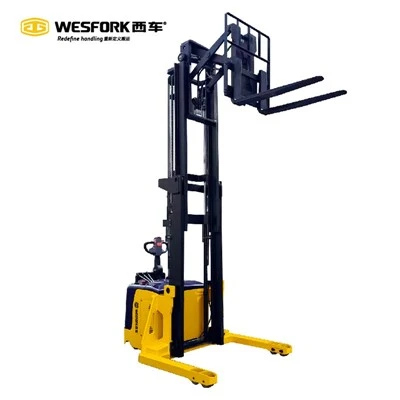
If you’re in the market for a 5-ton electric forklift and you’re not sure what lift height is right for your operation, or if you’re worried about capacity, stability, or fitting your existing space, we’re here to help. We’ve helped hundreds of warehouses and manufacturing plants across North America match the right forklift to their needs, no matter how big or small their lift height requirements are. You don’t have to guess—let us walk through your application with you, answer all your questions, and make sure you get a forklift that’s safe, efficient, and built to last.
Ride Reach Truck References
OSHA Standards for Powered Industrial Trucks, 29 CFR 1910.178
Electric Forklift Design and Performance Specifications, Industrial Truck Association
Cold Storage Forklift Operational Guidelines, Material Handling Industry Association
Forklift Lift Height and Capacity Relationships, University of Illinois Extension Center for Agricultural Safety and Health
WESFORK Industries (Zhejiang) Co., Ltd.
As one of the most professional electric forklift manufacturers and suppliers in China, we also support customized service. Please feel free to wholesale high quality electric forklift for sale here from our factory. For price consultation, contact us.
Address: 277#Yinhu Road,Yinhu Street,Fuyang District,Hangzhou City,Zhejiang Privince,China
E-mail: sulin@wesfork.com
WebSite: https://www.wesforkintl.com/
