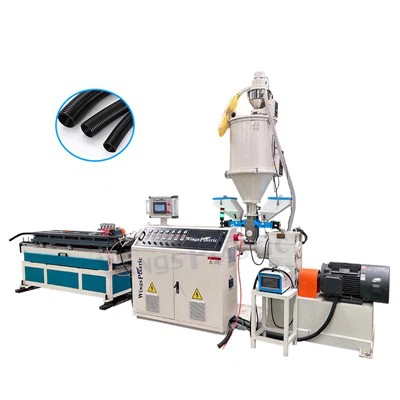
Hey there, thanks for stopping by my blog—if you’re reading this, chances are you’re either in the market for an underground pipe solution, or you’ve been googling “plastic corrugated pipe machine” for a side gig or a new project. I get it, because I’ve been deep in this game for 12 years now, and one question pops up so often I lost count: Can a plastic corrugated pipe machine actually make pipes for underground use? Let’s cut through the jargon here—no stuffy industry lingo, just the real deal. Plastic Corrugated Pipe Machine

First, let’s start with the basics. A lot of people confuse plastic corrugated pipes with the flimsy stuff you see holding up garden hoses, or the thin drainage pipes for flower beds. That’s not what we’re talking about here. Underground pipes need to hold up to way more than just a little dirt and water—they’re sitting under driveways, farm fields, even roads, so they have to stand up to heavy loads, soil pressure, roots, and sometimes even chemicals from fertilizer or runoff.
So, can our machines make that? Short answer: Hell yeah, they can. But it’s not just any plastic corrugated pipe that works for underground. The key here is the material we use, and the settings on the machine that we tweak. Let’s break it down. The most common material for underground pipes made on our machines is HDPE—high-density polyethylene. Unlike PVC, which gets brittle when it’s cold and cracks easily underground, HDPE is flexible, durable, and resistant to corrosion. That’s why it’s the go-to for sewer lines, drainage, and even water mains in a lot of places. Our machines are set up to extrude HDPE, but we can adjust them for other materials too, like PP (polypropylene) if someone needs a stiffer pipe for specific applications.
Wait, let’s get specific about how the machine works for underground pipes. A plastic corrugated pipe machine doesn’t just melt plastic and push it out—this one is a two-step process, basically. First, the extruder melts the plastic resin into a uniform melt, then it gets fed into a corrugator head that shapes it into those repeating ridges. For underground, those ridges aren’t just for show—they add structural strength. That corrugated design lets the pipe flex a little under heavy loads (like a semi-truck driving over a driveway) instead of cracking, which straight pipes often do. Our machines have adjustable corrugation profiles, too—so if you need a deeper ridge for a high-load area, or a shallower one for a light drainage line, we can program that in. No extra equipment needed, just a quick setting change.
Now, let’s talk about what makes a pipe “good enough” for underground. A lot of new guys think any corrugated pipe will work, but there’s a catch: wall thickness and structural rating. For underground, you need a pipe with a minimum ring stiffness—usually between 4 kN/m² and 16 kN/m², depending on the depth it’s going under. If you put a low-ring-stiffness pipe under a road, it’ll collapse within a year, and that’s a huge mess. Our machines are built to produce pipes with consistent ring stiffness, because we use precision cooling and sizing systems. No warped walls, no weak spots—every inch of the pipe is the same strength, which is non-negotiable for underground use.
I know some of you might be thinking, “But what about the cost?” A lot of people assume underground pipes have to be super expensive, but plastic corrugated pipes made on our machines are actually cheaper than concrete or metal pipes. Concrete cracks, metal rusts, and both are heavy to transport and install. Our plastic pipes are light, so you can ship more of them per truck, and they’re easy to cut on site with a regular saw. That cuts installation costs big time. Plus, they last 50+ years underground—way longer than a lot of alternatives. I’ve had customers tell me their HDPE corrugated pipes are still going strong after 30 years, no issues.
Wait, let’s address the myths I hear all the time. First myth: “Plastic pipes leach chemicals into groundwater.” Yeah, that’s old news. Modern HDPE is FDA-approved for potable water applications, so if you’re using it for a water line, you don’t have to worry about that. For drainage or sewer lines, it’s even safer, because it doesn’t react with sewage like metal or concrete can. Second myth: “Corrugated pipes get clogged easier.” No, not if they’re made right. Our machines can produce smooth inner walls on corrugated pipes (a dual-wall design, basically) so debris and sediment slide right through. That’s a big upgrade from old corrugated pipes with rough inner walls that caught everything. The dual-wall design also adds even more strength, which is perfect for deep underground installs.
Now, how does the machine factor into all of this? If you’re running your own plastic corrugated pipe shop, you can’t just buy a basic machine and make underground pipes. You need a machine with certain features: a high-torque extruder for HDPE, a closed-loop cooling system to keep the corrugations uniform, and a puller with enough grip to handle thicker walls. Our machines come with all that, and we offer custom tweaks too. Last year, we had a customer who needed pipes for a farm drainage system, so we adjusted the machine to make smaller diameter (6 inch) pipes with medium ring stiffness—they loved it, and saved 30% on installation compared to the PVC they were using before. Another customer did a municipal sewer line, and they used our machine to make 12-inch pipes with high ring stiffness that can go under a major highway. No complaints there.
What about maintenance? I know nobody wants a machine that breaks down every other week. Our plastic corrugated pipe machines are built with heavy-duty parts, and we offer ongoing support—like troubleshooting guides, spare parts, and even on-site training if you need it. A lot of our competitors sell machines and disappear, but we’re here for the long haul. I remember one customer who had a small issue with a corrugator head 6 months after buying, and we had a technician on their farm within 48 hours to fix it. That kind of support matters when you’re relying on your machine to make money.
Wait, let’s get real about use cases. What do people actually use these pipes for underground? Let’s list a few: municipal drainage systems, farm tile drainage, sewer and lateral lines, road culverts, residential foundation drainage, even underwater pipelines for lakes or rivers. All of these can be made on a plastic corrugated pipe machine. The only time you might need a different machine is if you’re making super large diameter pipes (like 48 inches or more), but even then, we can adjust our machines to handle that size—we’ve done it before for water projects.
Now, if you’re thinking about getting into this, or upgrading your current machine to make underground pipes, what should you look for? First, make sure the machine is compatible with HDPE (that’s the main material for underground). Second, check the ring stiffness capability—you want at least up to 16 kN/m² for heavy loads. Third, look for a machine that can do dual-wall pipes, because the inner smooth wall is a game-changer for clogs. And last, work with a supplier who doesn’t just sell you a machine—they’ll help you with the settings, material selection, and even market info, because this stuff is about more than just the equipment.
I should also mention that a lot of people use our machines to make both corrugated pipes for underground and other products, like garden hoses or conduit for electrical lines. It’s versatile, which means you can diversify your product line without buying a whole new machine. That’s a big plus for small business owners or startups who don’t want to tie up all their capital in one piece of equipment.
Let me wrap this up. The answer to “Can a plastic corrugated pipe machine be used for underground pipes?” is a resounding yes—if you have the right machine, the right material, and adjust the settings for the structural needs of underground use. It’s not a gimmick, it’s a proven, cost-effective solution that’s been used for decades. The key is partnering with a supplier who knows what they’re doing, because not all machines are built the same.
If you’re tired of your current machine not being able to make durable underground pipes, or if you’re just starting out and want to get into the corrugated pipe game, I’d love to chat. We can go over your specific needs—whether it’s small farm drainage lines, big municipal sewer projects, or anything in between. No hard sells, just honest advice about what works and what doesn’t. Just reach out if you want to talk numbers, machine specs, or anything else related to plastic corrugated pipe machines for underground use.
PVC Hose Machine References
- Plastics Industry Association. (2022). HDPE Pipe for Underground Infrastructure: Performance and Applications.
- American Society of Civil Engineers. (2021). Structural Design Requirements for Corrugated Plastic Underground Pipes.
- National Agricultural Drainage Association. (2020). Plastic Corrugated Pipe for Farm Drainage Systems.
- Polyethylene Pipe Institute. (2019). Dual-Wall Corrugated Pipe Installation and Longevity Data.
- Equipment and Manufacturers Association. (2023). Best Practices for Operating Plastic Corrugated Pipe Machines for Underground Pipe Production.
Qingdao Wings Plastic Technology Co., Ltd.
As one of the most experienced plastic corrugated pipe machine manufacturers and suppliers in China, we also support customized service. Please feel free to buy durable plastic corrugated pipe machine made in China here from our factory. For price consultation, contact us.
Address: C02 Of Anshengyi Road, No.2 Fuan Industry Zone,Jiaodong Town, Jiaozhou City, Qingdao City, Shandong Province, China
E-mail: kelly@wingsplastic.com
WebSite: https://www.wingsextruder.com/
