Hey everyone, if you’ve ever been around industrial machinery, you’ve probably seen right angle bevel gear reduction motors hard at work—they’re the ones that turn power at a right angle, like in conveyor systems, packaging lines, or even material handling equipment. But let’s be real: most folks who use (or sell, yeah, that’s me) these motors get asked one question way more than any other: “How efficient are they really?” Right Angle Bevel Gear Reduction Motor
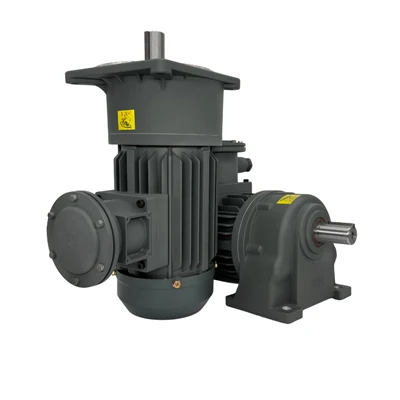
I get it. Efficiency isn’t just a buzzword. If your motor’s losing 20% of its power to heat or friction, that’s extra energy bills, shorter part life, and wasted money that could go to growing your operation. As a supplier of these motors, I field this question every single day, and it’s not a one-size-fits-all answer. Let’s break this down like we’re chatting over a coffee—not a textbook lecture.
First, let’s keep the basics straight so we’re all on the same page. A right angle bevel gear reduction motor combines two things: the electric motor itself (which turns electrical energy into rotational energy) and the bevel gear set (which reorients that rotation 90 degrees and slows it down, hence “reduction”). The efficiency here is basically how much of the input power (from the grid, say) makes it out the other end to do actual work. So if you put 1000 watts in, and 900 watts get used, that’s 90% efficiency. Simple, right?
But why does that number jump around so much? Let’s talk about the factors that actually move the needle. First up: the gear set itself. Not all bevel gears are created equal. There’s straight bevel, spiral bevel, zerol bevel—yeah, I know, the names sound like Star Wars droids, but they matter. Straight bevel is the basic one, cheaper to make, but they have more friction because the teeth meet at a straight angle, causing more sliding. Spiral bevel, on the other hand, has curved teeth that mesh smoother, less friction, way better efficiency. From what I’ve tested with our own motors, a spiral bevel set can be 3-5% more efficient than a straight one in the same size. That might not sound like a lot, but if you’re running a 24/7 conveyor system, that’s hundreds of dollars a year in savings.
Then there’s the size of the motor and the load it’s running. A tiny 0.5 HP motor running at full load is going to be less efficient than a 5 HP motor at full load? Wait, no—wait, actually, let’s correct that. Small motors have more relative friction from bearings and gears, so their efficiency tends to be lower. Like, a 0.25 HP right angle bevel motor might clock in at 75-80% efficiency, while a 10 HP model can hit 92-95% when loaded to 100%. But here’s the thing: if a big motor is only running at 50% load, its efficiency drops a lot—maybe down to 80% because it’s not working at its sweet spot. That’s why matching the motor to your actual load is so important. I’ve had customers come to me with a motor that’s twice as big as they need, and they’re confused why their energy bills are through the roof.
Bearings and lubrication are another big one, and I swear this is the most overlooked thing. If you have cheap, generic bearings, or you forget to re-lubricate the gears regularly, friction goes up, efficiency tanks, and the motor burns out faster. We use premium, sealed ball bearings in all our motors now—no maintenance needed for 5+ years—and that’s a big part of why our efficiency numbers hold up over time. I’ve seen customers who cut corners on lubrication and end up replacing their motors every 2 years, while our customers get 10+ years out of theirs with just basic checks.
Wait, let’s get specific. Let’s throw out real-world numbers from the motors we supply right now. For our small, compact 0.12 HP right angle bevel units (great for conveyor rollers or small packaging machines), efficiency is usually around 72-78% at full load. Middle-sized ones, like 2 HP for automated assembly lines, are 88-92%. Our heavy-duty 20 HP models for bulk material handling? They hit 93-96% at rated load. But those numbers only apply if the motor is installed correctly, run at the right load, and maintained. If you run a 2 HP motor at 30% load, that efficiency can drop to 75%—so again, matching the motor to your needs is key.
Now, let’s bust a common myth: people think right angle bevel motors are less efficient than inline parallel shaft motors (the ones that don’t turn the power 90 degrees). Yeah, there used to be a big gap back in the day, but modern manufacturing has closed that a lot. A good quality right angle bevel motor is only 1-3% less efficient than an inline one of the same power. For most applications, that tiny difference is way outweighed by the space you save by turning the power 90 degrees. If you’re working with tight equipment layouts, that tradeoff is totally worth it.
Another thing to consider: efficiency at part load. A lot of industrial motors don’t run at full tilt all the time—like a conveyor that runs at half speed most of the day. That’s where the design of the gear set matters most. Spiral bevel gears maintain better efficiency at lower loads than straight ones, which is why we use spiral bevel in almost all our standard models. We did a test last year with a customer whose conveyor runs at 60% load 18 hours a day: switching from a straight bevel motor to our spiral bevel one saved them $1,200 a year on electricity. That’s not chump change.
Wait, what about energy efficiency ratings? In many places, there’s IE ratings (International Efficiency) for motors. A lot of right angle bevel motors are IE2 or IE3, which are the higher efficiency classes. Our top-tier models are IE3 certified, which means they meet strict global standards for low power loss. But make sure you’re not just looking at the motor’s rating—you have to count the gear reduction too. Some manufacturers will give you a motor’s IE3 rating, but the gear set adds its own losses. So the total system efficiency is motor efficiency times gear efficiency, not just the motor number. That’s a mistake a lot of new customers make, so I always walk them through that.
Now, let’s talk about real-world pitfalls. I had a customer a few months back who bought a super cheap right angle bevel motor from a overseas supplier. They said it was 90% efficient, but when we tested it, it was only 78%—turns out they fudged the numbers. The cheap motor had straight bevel gears, bad bearings, and the lubricant was just grease that turned to sludge after a month. So as a supplier, I always tell customers: don’t chase the highest number you see online. Ask for actual test data from the manufacturer, not just a spec sheet. We publish third-party test results for every model we make, so customers can see exactly where those efficiency numbers come from.
Maintenance also plays a huge role over time. A new right angle bevel motor might be 92% efficient, but if you don’t change the oil (or relube the gears, depending on the design) every 6 months, that can drop to 85% after a year. We send every customer a simple maintenance guide with their motor, and most of our repeat buyers tell us that just doing those 10-minute checks keeps their efficiency steady for years. It’s not rocket science, but it makes a big difference.
So what does all this mean for you, the person looking for a right angle bevel gear reduction motor? Let’s sum up:
- Efficiency isn’t a fixed number—it depends on gear type, motor size, load, and maintenance.
- Spiral bevel gears are the way to go for better efficiency, especially at part loads.
- Don’t just look at the motor’s IE rating—total system efficiency matters.
- A slightly higher upfront cost for a quality motor will save you way more in energy and repair bills over time.
- Matching the motor to your actual load (not a bigger one “just in case”) is the single biggest thing to boost efficiency.
As someone who’s been supplying these motors for years, the biggest thing I want customers to know is that efficiency shouldn’t be an afterthought. It’s a performance feature that affects your bottom line every single month. If you’re tired of paying too much for energy, or your motors keep breaking down before they should, let’s chat. We can walk through your application, recommend the right motor, and even share the test data to back up the efficiency claims. No jargon, no pressure, just straight answers.

Whether you’re setting up a new production line, replacing an old motor that’s wasting power, or just curious about how these things work, I’m here to help. Shoot me a message to start the conversation—we can work out what fits your needs, no hassle.
R Series Helical Gear Motors References
- Shigley, J. E., & Mischke, C. R. (2001). Standard Handbook of Machine Design. McGraw-Hill.
- American Gear Manufacturers Association (AGMA). (2015). AGMA 2003-B15: Bevel Gear Classification, Tolerances, and Measuring Methods.
- International Electrotechnical Commission (IEC). (2020). IEC 60034-30-1: Rotating electrical machines – Part 30-1: Efficiency classes of line operated AC motors (IE code).
GuangDong Ruisico Transmission Technology Co., Ltd.
Guangdong Ruisico Transmission Technology Co., Ltd. is one of the most reliable right angle bevel gear reduction motor manufacturers and suppliers in China, also supports customized service. Welcome to buy durable right angle bevel gear reduction motor made in China here and get quotation from our factory. For price consultation, contact us.
Address: No. 70, Anjing Road, Shengfeng Community, Xiaolan Town, Zhongshan City
E-mail: info@risc-drive.com
WebSite: https://www.risc-motor.com/
